Arrange a new electricity supply
Arrange a new electricity supply
Whether you’re moving into a property or building on an unpowered block, we can help get you connected. We can also provide a short‑term power supply to support construction and building works.
Just moved in
If you’ve moved into a home or business where an electricity meter is installed, you can contact an energy retailer to get the power turned back on. To compare retailers, plans and prices, visit the Victorian Government’s Energy Compare website (opens external site in a new window).
Apply for new electricity connections
If electricity is not currently connected to a permanent supply, or you need a supply greater than standard, you’ll need to apply for a new electricity connection.
The process depends on whether the existing electricity network in your street can support your requested supply.
You’ll need to engage a Registered Electrical Contractor (REC) early. This will help you avoid unexpected costs or delays.
They can:
- Assess your requirements.
- Identify any required upgrades.
- Advise you on the new connection process.
If electricity supply is readily available
Electricity supply is readily available when we don’t need to upgrade or extend the network to support your needs.
This typically includes:
- new overhead connections to existing power poles or underground pits on the property boundary
- new connections for new homes and businesses
- temporary connections, such as a builder’s temporary supply.
If you’re not sure whether we can provide the power supply you need, contact our Customer Requests team on 1800 771 434 (Monday to Friday, 8am - 4pm) to discuss your options. This includes properties in remote areas where powerlines are limited on the road reserve or private land.
How to apply
New connection applications can only be submitted by a qualified registered electrical contractor (REC). All works require a Certificate of Electrical Safety.
You can submit your application through our online portal, eConnect.
Once registered and logged in:
- Select Submit Connection Request.
- Select New Connection.
- Complete and submit the form.
New to eConnect? Visit our How to use eConnect support article to learn how to access the portal and submit a request.
Costs and Timeframes
Typical new connection costs range from $600 to $4,100, depending on phasing and metering requirements. Please note these charges are additional to any pit installation costs that may apply.
Connection timeframes vary and can’t be confirmed until we assess your application. In most cases, the process takes 4 – 10 weeks. However, timelines may vary as the process relies on third parties to provide required information. It may take longer due to missed appointments, unsuccessful field visits or delays with retailer service orders.
We’ll contact your electrician if we need more information or if there are changes. There’s no need to follow up if your application is within the advised timeframe.
If electricity supply is not readily available
If your site needs more electricity than what is considered standard on our network, we’ll need to assess our assets before you can connect. This is to ensure we can safely and reliably supply the electricity you need.
In this case, you will need to submit your request through mySupply. Once we have received your application, we’ll:
- Validate all supporting documentation and information.
- Make sure you can connect via your preferred method (overhead or underground).
- Check the phasing and capacity of our assets that would supply the site.
- Undertake a voltage assessment to ensure a reliable supply of electricity.
Once we have completed these checks, we’ll provide you with a formal supply capacity offer and contact you if further information is required.
If the existing overhead or underground infrastructure can’t support the new or modified connection, we may need to upgrade or extend the electricity network. If this is the case, we’ll provide you with an offer for this work.
If we need to extend, alter or upgrade the network
If electricity infrastructure is not currently available or needs to be upgraded, you will need to submit an application through mySupply.
Common examples include:
- new developments or subdivisions
- large homes or high-demand businesses
- sites with substantial electricity load requirements
- high voltage (HV) supply and major projects
- unmetered supplies
- temporary supply.
For more information about pits, visit the Pit installations page.
How to apply
You can submit your application through our online portal, mySupply.
Once registered and logged in;
- Select Get Power.
- Select Residential or commercial.
- Select New or increased supply.
- Complete the application form.
- Make payment for the calculated upfront application fee.
- Submit the form.
You will need to provide the following documents:
- site plan (mandatory)
- AS3000 (mandatory for requests over 80 amps)
- plan of subdivision (mandatory for subdivided properties)
- cover letter (optional)
Costs and timeframes
The cost for us to complete the works will be provided to you once we have assessed your request. Depending on the complexity of the work involved, we may need to undertake a preliminary design prior to issuing you with a cost for completing the works.
You can use our Quick Calculator tool to obtain an indicative cost for new supplies to new residential or small business. Before entering any financial agreement, we strongly suggest you obtain a firm cost from us. To get a confirmed cost, you’ll need to submit an application through our mySupply portal. We’ll then review your request and work out what’s involved.
We will provide you a specific timeline for your project in the offer we send you.
Types of connections
A temporary builders supply may be required as part of customer development works. For larger projects, this connection is usually achieved through a temporary means while the permanent connection is constructed.
Typical options for temporary supply include:
Up to 160 amps per phase
- an overhead service to a builders temporary pole
- underground pit
Greater than 160 amps
- dedicated underground circuits
- substation on site
An overhead connection service provides electricity to your property via powerlines that run above ground, typically from a nearby pole to your building.
The maximum supply that can be provided via an overhead service is typically 160 amps per phase.
A new or updated overhead supply must comply with the current Victorian Service and Installation Rules (opens external site in a new window).
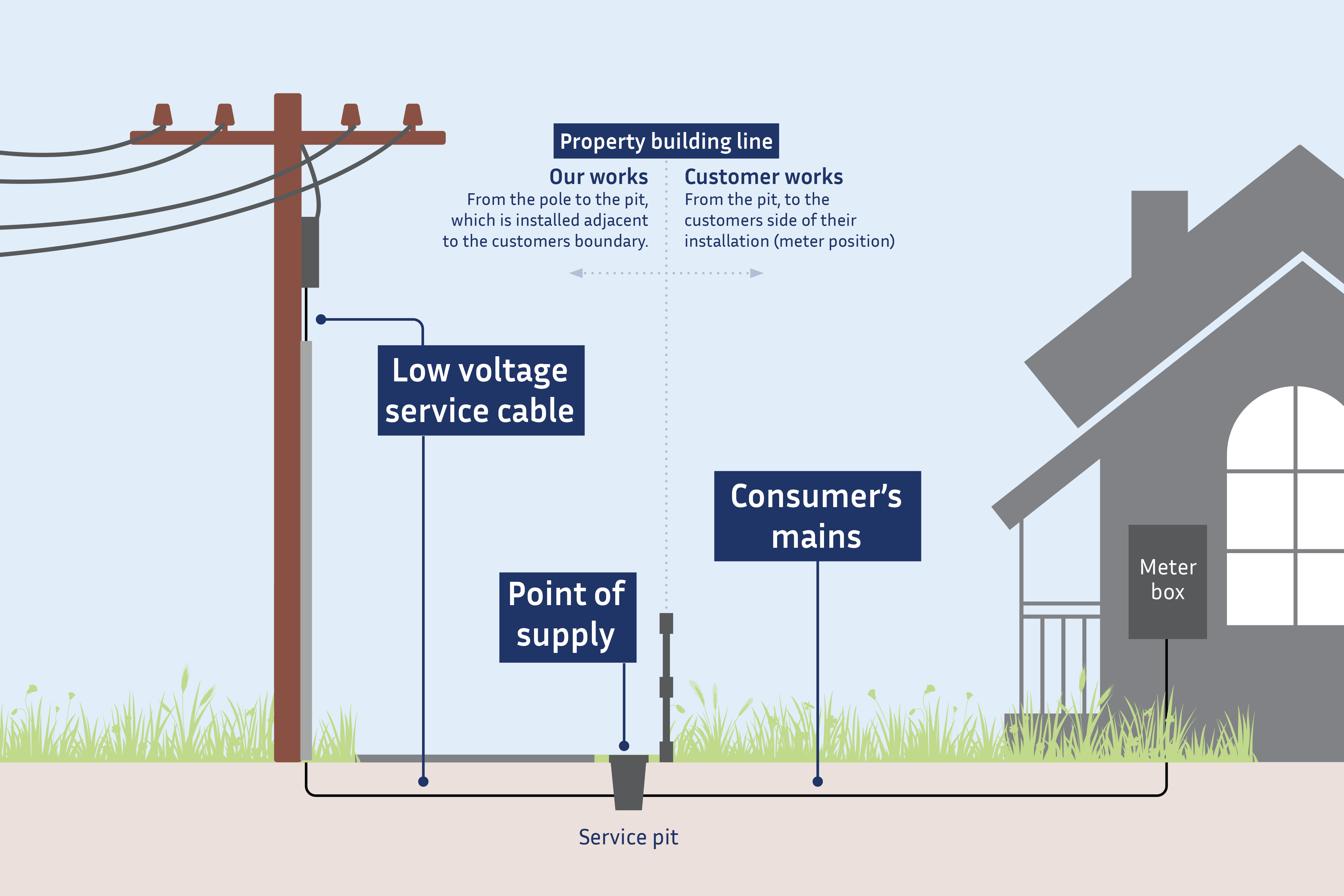
A pit is an underground low voltage point of supply installed at the property boundary. This can be connected to a nearby power pole, or to existing underground low voltage mains in the street.
The maximum supply that can be provided via an electricity pit is 160 amps per phase.
- Visit the Pit Installations page to understand the process and apply.
- Engage a Registered Electrical Contractor (REC) to install cables from the pit to your main switchboard.
An unmetered supply may be available when it is not practical to install or maintain a meter.
To be eligible:
- The connection must be small (less than 2 amps).
- You must be an approved unmetered supply customer.
Common unmetered connections include:
- NBN cabinets
- CCTV cameras
- electronic parking meters, bus shelters or phone boxes.
All unmetered supplies must have an agreement in place prior to connection.
Apply for an unmetered supply in mySupply.
A dedicated circuit is a low voltage underground connection from an external substation to a customer service facility (SCF) located within the customer’s property for supplies up to 315 amps per phase.
A new or upgraded dedicated circuit must comply with the current Victorian Service and Installation Rules (opens external site in a new window).
Requires a preliminary design to be completed via a Specification and Design Services Contract (SDSC) prior to the issue of Negotiated Connection Contract (NCC). Typical timeframes range from 20 to 28 weeks.
Upon full acceptance of Negotiated Connection Contract (NCC), typical timeframes for construction works range from 24 weeks to 46 weeks.
Please note that these timeframes are subject to completion of customer obligations stipulated in the SDSC and NCC agreements. Additional time will be required for vegetation clearance, environmental approvals, cultural heritage management approvals, easement negotiations, planning permits and/or third-party approvals and/or consents.
Large supplies greater than 315 amps per phase may require their own onsite substation.
Typical options
- indoor substation
- kiosk substation
- pole substation
Requires a preliminary design to be completed via a Specification and Design Services Contract (SDSC) prior to the issue of Negotiated Connection Contract (NCC). Typical timeframes range from 26 to 32 weeks.
Upon full acceptance of Negotiated Connection Contract (NCC) and execution of Agreement to Lease (AFL), typical timeframes for construction works range from 36 weeks to 46 weeks.
Please note that these timeframes are subject to completion of customer obligations stipulated in the SDSC and NCC agreements. Additional time will be required for vegetation clearance, environmental approvals, cultural heritage management approvals, easement negotiations, planning permits and/or third-party approvals and/or consents.
Lease agreement is required to be executed prior to energisation of the new substation in accordance with NCC agreement
For the delivery of our connection services there are two options:
Option 1 is that we construct the connection assets for an agreed fee.
Option 2 is where the partner or developer constructs the connection and then gifts the assets to us under our contestability framework, for example, a connection to a new housing estate. Under the second option, we then assume responsibility for the ongoing maintenance of these assets.
If you want to manage your own tender, visit our Contestable works page.