Tree cutting near powerlines
Tree cutting near powerlines
Overgrown branches near powerlines can pose risks such as power outages or fires, especially during severe weather conditions.
This is why we regularly inspect trees around our poles and wires and cut them back as necessary. Trees are trimmed and maintained in a way that helps us deliver a safe and reliable electricity supply while adhering to electricity safety regulations. While we understand the tree’s appearance after trimming may not always be aesthetic, it ensures that we’re keeping our community safe.
It is important we all play our part to keep our community safe, including you.
Property access
To ensure we can deliver a safe and reliable electricity supply, we need to be able to inspect and maintain trees near our powerlines and poles. At times this may require us to access your premises. Under the Electricity Safety Act you must provide us and our authorised representatives with safe and unhindered access to your premises.
We will leave a printed notification at your property between 14 and 60 days before tree trimming is happening in your area, and where practical, we will notify you before accessing your property
Who's responsible for managing trees near powerlines?
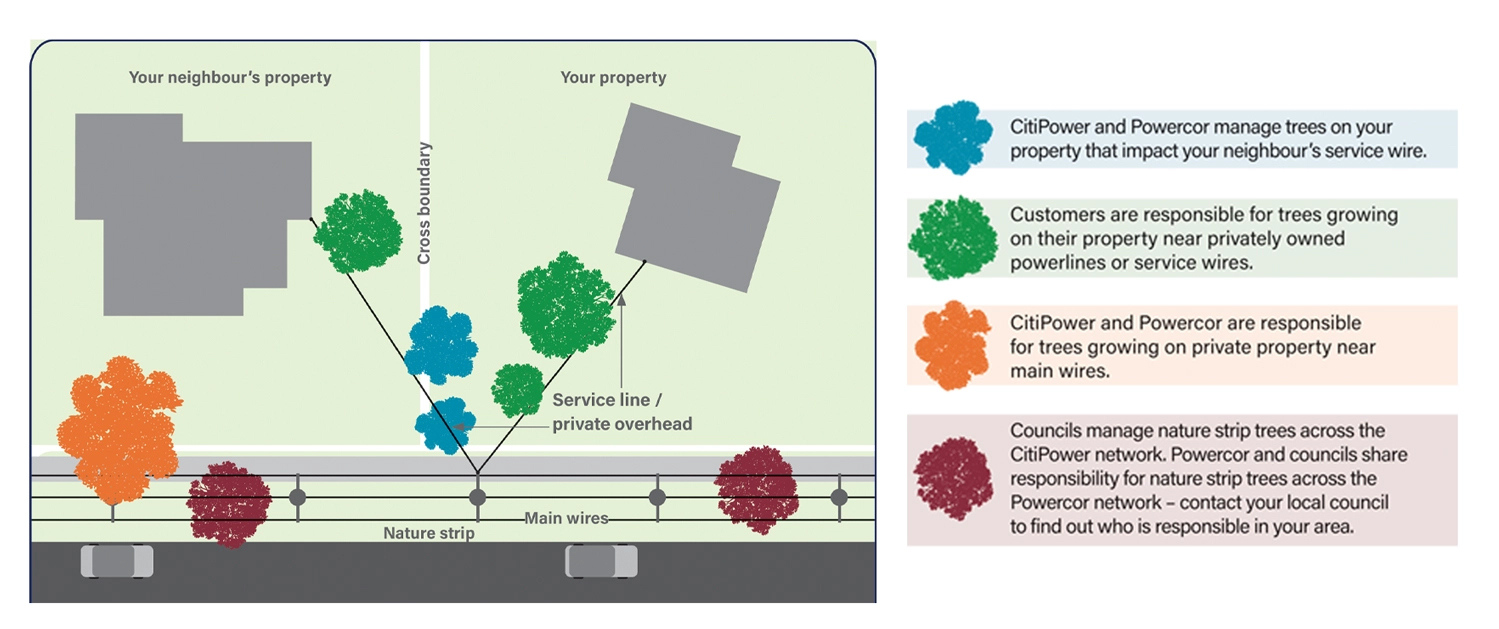
We have an obligation to clear any vegetation that poses a risk to our assets. The Electricity Safety Act, including the Electrical Safety (Electric Line Clearance) regulations require us to meet certain minimum standards, including maintaining the clearance distances between trees and other vegetation near high voltage and low voltage powerlines.
We are responsible for maintaining trees:
- growing on private property which branch out near the main wires.
- on your property that impact your neighbour’s service wire.
- on certain nature strips across Powercor network (have a look at the diagram below to find out who is responsible in your area).
If we see trees on your property that need to be cut, we’ll leave a notification in your letterbox.
You are required to keep trees away from the Private Electric Line (previously known as Private Overhead Electric Line or POEL) or service wires at your property.
Can I cut the tree myself or do I need to hire a contractor?
Working near live powerlines is dangerous. The electricity safety regulator has created the Tree No Go Zone to define the minimum safe distance when working near powerlines. Only workers authorised by CitiPower and Powercor can trim trees within the No Go Zone. You can request this service by completing our Tree No Go Zone cutting enquiry form.
If you’re planning to remove a tree within the Tree No Go Zone, you’ll need to submit a request and we’ll provide you a quote for the work. It is important that you ensure you have the required permits from your local council before the cutting takes place.
If your tree growth is outside the Tree No Go Zone, you are allowed to cut this yourself, or hire a contractor.
Learn more about the Tree No Go Zone on our No Go Zones page.
Never attempt to clear branches that have fallen onto a powerline.
Planting around powerlines
One of the best ways you can keep trees away from powerlines, is to avoid planting underneath or directly next to powerlines altogether. A tree may look small now, but many species will grow far taller than the clearance distance required to keep our powerlines safe and can become a major safety issue.
Council permission and permits
Council permits may be required for your tree trimming. It is your responsibility to apply for the relevant council permits before CitiPower and Powercor commence work. We recommend contacting your local council directly before submitting a request.
Local councils or shires are responsible for managing nature strip trees in the CitiPower network and share the responsibilities with us across the Powercor network. They are also responsible for selecting and planting tree species that won’t interfere with powerlines. Have a look at the diagram below to find out who is responsible in your area.
If you have concerns about local trees, whether they are near powerlines or not, contact your local council.
Our tree cutting program
We inspect and cut trees around powerlines to ensure they stay a safe distance. Depending on the tree species and location, we may carry out additional trimming where the regular cycle isn’t sufficient to provide enough clearance. Trees are cut to meet safety requirements plus additional space allowed for regrowth, to ensure power safety.
Generally, our program will focus on rural (higher bushfire risk areas) areas while paddocks are dry and accessible before moving to urban (lower bushfire risk areas) during the wetter winter months.
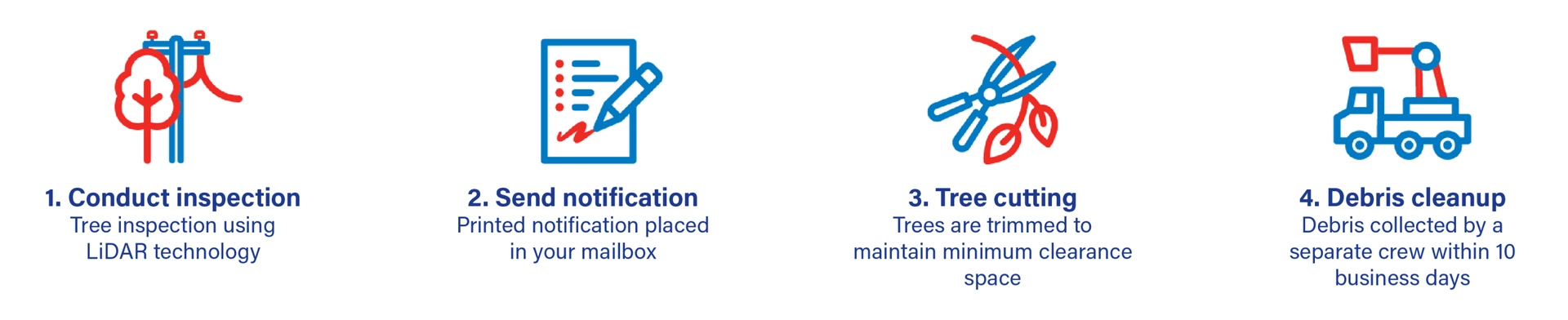
We assess trees using LiDAR technology (opens external site in a new window) to measure the distance between trees and the powerlines and plan where and when to cut.
We inspect all our powerlines in both low and high bushfire risk areas each year. Spans where trees have been trimmed in the past 12 months will be scheduled to inspect again during the next maintenance cycle for that area.
Before trimming the trees, we will leave a printed notification at your property between 14 and 60 days in advance. The phone number on the notification will allow you to talk directly to the team planning the work. If you still have questions, you can contact us on our general enquiries numbers (Powercor 13 22 06 or CitiPower 1300 301 101)
However, where urgent pruning is required due to trees being within the clearance space around powerlines, the normal 14-day notification period does not apply, as outlined in the Electricity Safety (Electric Line Clearance) Regulations 2020.
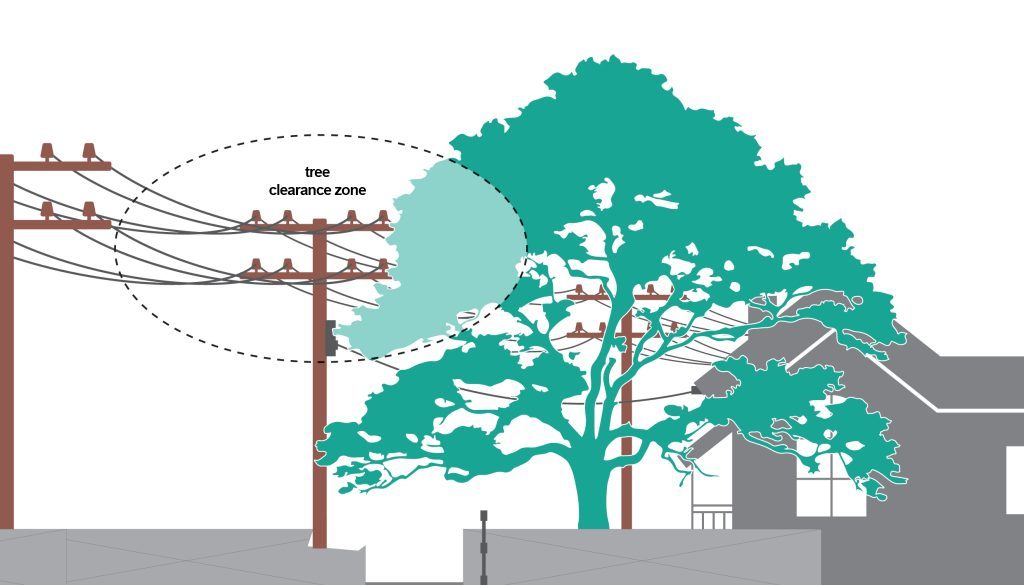
We need to maintain a safe clearance space between trees and our powerlines to keep everyone safe and maintain a reliable supply of power.
We’ll trim trees back to meet safety clearance rules (which can be up to three metres) and allow space for two years of growth. If you’re in a bushfire-prone area, we may need to cut more.
Fast-growing tree species need to be cut back further. There’s no cost to you. We manage tree cutting around our powerlines.
Some trees may look unusual once they’ve been cut. In all cases trees are cut in specific ways to keep the public safe, to keep the trees healthy and to ensure the network runs smoothly.
Tree trimming within the Tree No Go Zone
In many cases the Tree No Go Zone distance is greater than the clearance distance we are required to maintain. If the branches you need cut fall within the No Go Zone but outside our compliance obligations, you’ll need to submit a request for this work to be completed at your cost.
If additional cutting or removal is needed beyond this, it’s the landowner’s responsibility. We recommend speaking with a qualified arborist to understand what further work may be required.
A separate crew collects debris as the job requires different machinery.
We try our best to make sure that any debris from trimming is stored out of the way until the collection team can pick it up. Typically, field crews collect debris within 5 days in urban areas and 10 business days in rural areas from the time of cutting.
If you feel that the required time between cutting and collection has passed, please get in contact with us and we’ll get back to you as soon as possible.
Tree cutting enquiries
We offer different types of tree cutting requests. Use the information below to guide your enquiry and submit it through our myEnergy portal. You’ll need to register an account to submit a request. For Tree No Go Zone cutting enquiries, visit our No Go Zone page for more information.
Select this option if you have a tree that is too close to a powerline. After receiving your request, we’ll complete an inspection within 21 days. If the tree doesn’t meet our compliance obligations, we’ll arrange for it to be trimmed. If you are reporting a tree near powerlines, we will ask you to provide photos, so you may find it easier to complete it on your phone.
If you need cutting done within the Tree No Go Zone, including prepping to remove a tree, visit our No Go Zone page for more information. After receiving your request we’ll complete an inspection and send you a quote.
We inspect and cut trees on a regular maintenance cycle. When your area is due for cutting, we will leave a notification in your letterbox 14-60 days before. If you’ve requested a tree to be cut, assessments can take up to 21 business days, and trimming may take up to 12 months, depending on the urgency of the request.
A separate crew collects tree cutting debris because it requires different machinery. Debris is normally collected within 5 days in urban areas and 10 business days in rural areas after cutting. If it’s been more than 10 business days, complete the form in myEnergy and we’ll get back to you as soon as possible.
We know that some trees may look unusual once they’ve been cut. Trees are cut in specific ways to ensure public safety while keeping the trees healthy. Once we have cut the vegetation to be safe, you’re welcome to conduct further trimming for aesthetic purposes.
Submit a tree cutting enquiry
Tree cutting enquiries are made via myEnergy. Login or register and go to 'Customer Resolution Centre' section to start your enquiry.
